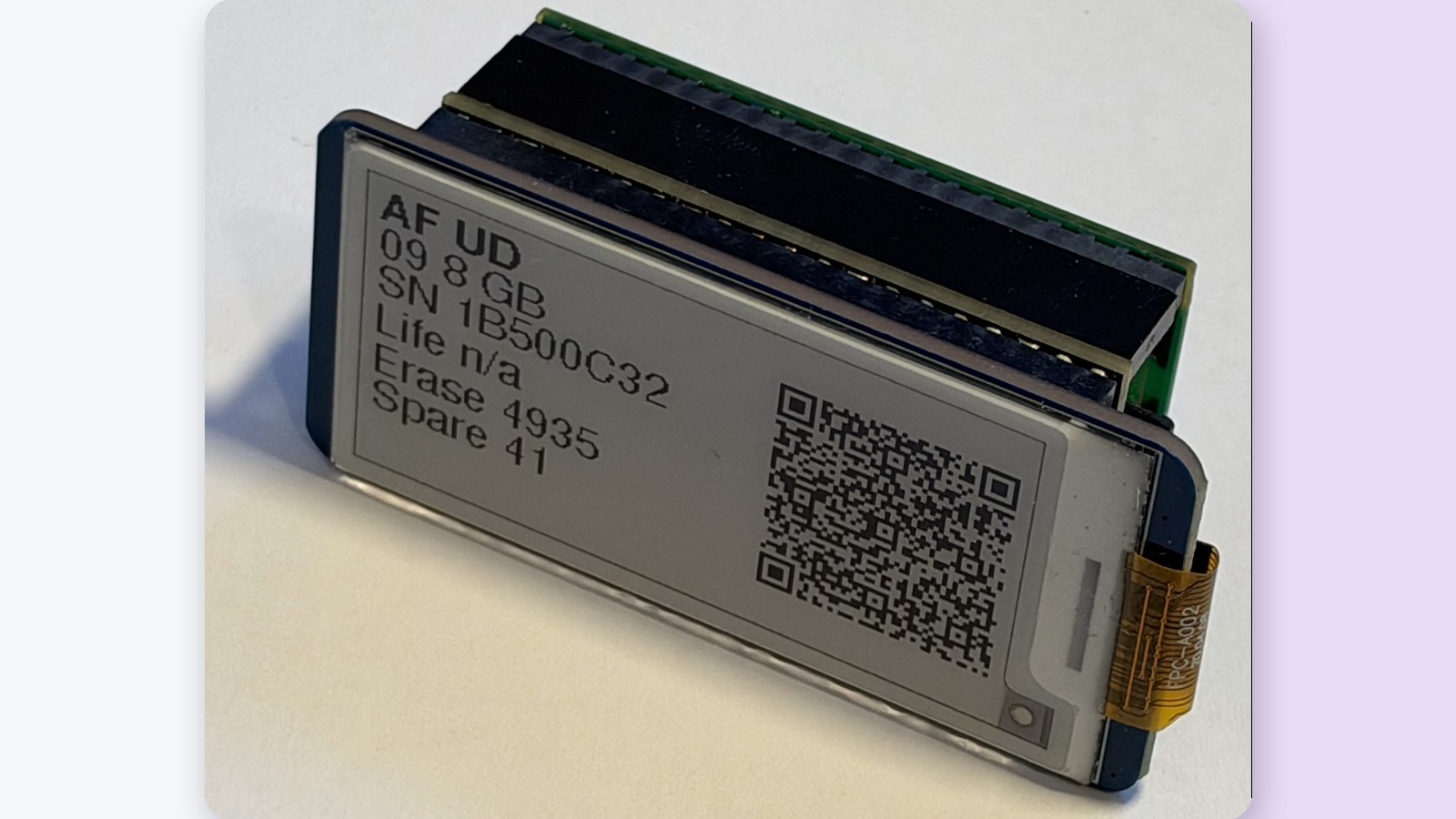
What a memory card knows about itself, and why we are asking its makers for the key
Industrial memory cards, and some high-endurance consumer cards, count their own wear. We decode those counters so a card's health can be read in the field. Here is what we can read today, what we cannot, and a specific request to the card and controller makers.
The diary inside the card
An industrial memory card is a small computer. Its controller manages the flash behind it, spreads writes across the blocks, retires the ones that fail, and keeps count. How many times each block has been erased. How many spare blocks remain. How often the power went away in the middle of a write. Those counters are the card’s own account of its life, and they are the best predictor of when it will stop working.
Most makers expose them through a vendor command that the card answers with a page of raw bytes. The command and the page layout differ from one controller family to the next, and they are rarely published.
What we can read today
We have spent this year decoding those pages one controller at a time, on a bench, with real cards: read the page, change the card’s state in a known way, read it again, and see which bytes moved. Where that work is complete, our readers show a remaining-life percentage and a grade, and every reading goes to the card’s passport in our portal, so the figure can be watched over time.
Today that is true for the ATP parts on two of the common Silicon Motion controllers, which are the cards most of our customers run. The readings have been checked against known erase counts, and the passport shows the counters rising as a card is used.
Where we hit the wall
For other controllers we can read the page but not all of it. One ATP family reports its erase total and its spare blocks but not the number of blocks, so the total cannot be turned into an average or a percentage. Some makers’ own controllers answer no vendor command at all, and the card gives us nothing beyond its identity.
When that happens our readers say so. The panel shows the counters it has and the words “Life not given”, and the passport carries the raw figures rather than a guess. We would rather show an honest gap than an invented percentage. We would also rather close the gap.
What we are asking for
The request is small per company and specific:
- The vendor command and page layout for the health data on your industrial parts. Several makers already share this under agreement with their larger customers; we will sign one.
- The block count and the rated erase cycles for each part number. These two figures turn a counter into a percentage, and a percentage into a grade.
- A few sample cards, new, so the decoding can be checked against a known starting point and the results tied to a part number rather than to a card that happened to be on the bench.
What we offer in return
Your customers get a reader that tells them the truth about your card, in the field, in seconds, and a passport that shows that truth over time. Our knowledge base carries a corrections policy: the moment you send us a figure, it replaces ours, and the entry says where it came from. Every maker who helps is credited by name in the knowledge base and in the passport of every card it covers.
Two makers have already helped: ATP and Delkin have shared information that made their parts readable, and we are grateful for it. We are now looking for the right contacts at other memory card and flash controller manufacturers, and we are happy to work under NDA. What you and your customers get in return: a reader that tells your customers the truth about your card in the field, cards verifiably wiped and returned to service with a certificate stating the grade achieved, benchmarks of how your parts actually wear across real fleets, and a corrections policy that puts your own figures above ours. If you work at a card or controller maker, or can introduce us to someone who does, get in touch.
Want the numbers for your media?
Get a rough estimate in seconds, then a fixed quote when you're ready.